




Electric cargo tricycles are more expensive and heavier than many ordinary products. Many manufacturers provide a specification sheet, but these sheets often don't explain how to choose the right model or what to look out for when buying one.
As a manufacturer and seller of electric tricycles, GIYI has created this guide to help you understand what to check and what to consider before purchasing an electric cargo tricycle.
The 8 checks that matter most
- The job. What will you carry, how far, and over what terrain?
- Layout. Front-load or rear-load changes handling more than any spec.
- True payload. Does the rating include riders and the trike itself?
- Motor and hills. Can it start and climb with your real load?
- Battery in watt-hours. Ignore "up to X miles" until you have done the math below.
- Brakes and holding on a slope.
- Size, weight, storage. Measure your doors and gate first.
- Rules and support. Know how your state treats it and who will fix it.
1. First, understand your own needs
|
Your main use |
What to prioritize |
Watch out for |
|---|---|---|
|
Two adults, or one adult plus errands |
A convertible seat, easy step-in, narrow body |
Total weight of riders plus cargo against the rating |
|
Groceries and errands alone |
A basket or box, stable low-speed handling |
Paying for capacity you won't use |
|
Family with young children |
A purpose-built box with 3-point belts and high sidewalls |
Trikes designed for adults only |
|
Small business or deliveries |
Higher payload, big battery, weatherproof storage |
Commercial-use limits in warranties and local rules |
|
Balance or mobility concerns |
Step-through entry, low center of gravity |
Learning the handling before carrying passengers |
2. Cargo trike or two-wheel cargo bike?
A trike stands on its own, so you never hold it upright while loading, and starting or stopping with a full load is easier.
Choose a trike if you carry passengers, stop often, or don't trust yourself to balance a loaded bike. Choose a two-wheeler if you ride long, fast, or narrow routes. For a wider look at who benefits, read our guide: Are Electric Tricycles Worth It?
3. Layout: front-load or rear-load
Front-load. You can see passengers and cargo, and the load sits low.
Rear-load. It steers like a bicycle and usually costs less.
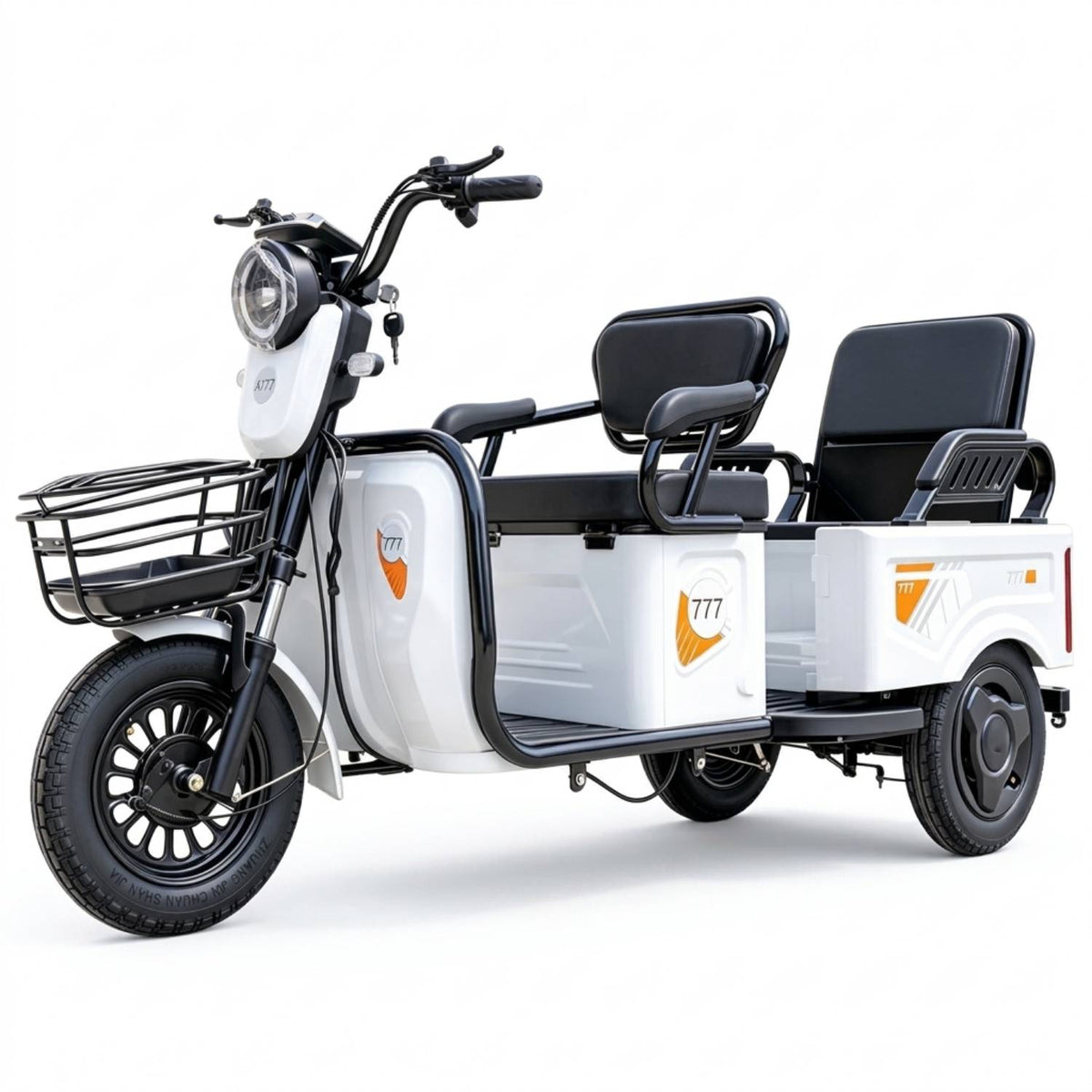
Our tricycle is rear-load: a convertible rear seat that flips into a cargo box, plus a front basket. Whatever layout you pick, check where the weight sits relative to the axles and whether the box blocks your view of the road.
4. Payload: read the rating before you trust it
Brands use "capacity" in two ways: payload or GVWR.
Example: a trike rated at 450 lb that weighs 130 lb empty. If 450 lb is GVWR, you have 320 lb for riders and cargo. A 180 lb rider, two children (100 lb together), and 40 lb of groceries use all 320 lb, leaving zero margin.
On ours, we list a 330.7 lb maximum load for passengers and cargo, with the trike's own 178.6 lb weight listed separately. That covers everyone and everything aboard: one adult, a passenger, and groceries fits comfortably; two large adults with a full load does not. We suggest planning your usual load at about 80% of any rating, because brakes and frame work hardest near the limit.
5. Motor, torque, and hills
Peak wattage on a listing describes a maximum, not what the motor sustains.
- Hub motor vs. mid-drive: hub motors are simpler and cheaper; mid-drives use the gears and climb steep hills more efficiently but cost more.
- Torque (Nm): useful for loaded starts, but not tested to one standard, so treat it as a rough guide.
- Gearing: if the trike has gears, low ones give you a fallback when the motor strains.
Our trike uses a 500W AC motor, with a listed climbing ability of up to 30° and a 20 mph top speed. A listed angle is a maximum under test conditions, so run your steepest hill, loaded, from a standstill before you decide.
6. Battery and range
Battery capacity is watt-hours: volts × amp-hours. A 48V 20Ah pack holds 960 Wh. Range claims depend on assist level, load, hills, speed, and temperature, and brands test them differently, so they can't be compared directly.
A practical estimate:
- Take the battery's Wh.
- Divide by 20–35 Wh per mile, a rule-of-thumb range for a loaded cargo trike.
- Use about 80% of the result as your safe range.
For 960 Wh that gives roughly 27–48 miles, or 22–38 with a reserve. Our listed 31 miles works out to about 31 Wh per mile, inside that range.
Lead-acid vs. lithium. Our battery is 48V 20Ah lead-acid. Lead-acid costs less upfront, but it is heavier, charges slowly (ours takes 8–9 hours), and usually has a shorter cycle life than lithium. Ask any seller the replacement price before you buy. For more on voltage, our 36V vs. 48V explainer is written for golf carts, but the logic is the same.
Safety certification. Lithium and lead-acid systems both deserve scrutiny. Look for UL 2849 or UL 2271, and ask any seller for documentation.
Charging at home: use the supplied charger, charge near a smoke detector and away from exits, never charge a damaged battery, and don't leave it charging unattended overnight.
7. Brakes, tires, and holding on a slope
- Brakes: hydraulic discs give the most feel and stopping power. Drum brakes, which ours uses front and rear, are sealed from rain and need little maintenance, and they suit neighborhood speeds around 20 mph.
- Holding on a slope: you need to load and unload without the trike rolling. If your driveway slopes, ask the seller how the trike holds there before ordering.
- Tires: wider tires grip and absorb bumps better. Ours are 3.00-8, with 9.4 in of ground clearance.
- Lights and signals: front headlight, tail light, turn signals, and a horn. We include all four, plus an LCD dashboard.
8. Passengers and cargo
For adults, check seat size and entry height. Ours has a front seat of 19.7 × 12.2 in and a rear seat of 22.0 × 12.2 in.
For children, the bar is higher: 3-point seat belts that stay on the shoulder, sidewalls tall enough to contain a child, a helmet for every passenger, and the manufacturer's minimum passenger age. Our tricycle is designed for adult riders and passengers. If carrying young children is your main reason to buy, choose a purpose-built front-box family trike instead.
9. Size, weight, and where it will live
- Width: a standard interior door is about 30–32 in wide and a typical entry door about 36 in. Ours is 27.6 in wide, 76.8 in long, and 43.3 in tall.
- Weight: ours weighs 178.6 lb and does not fold. You won't lift it onto a rack or up stairs, so plan a ramp or a ground-level spot.
- Security: weight deters casual theft but not a determined thief.
- Delivery: it arrives in 1–2 weeks, ships free across the lower 48 states from our U.S. warehouse network, and needs basic assembly. Tools and instructions are included.
10. US rules: what the law says
Federal law defines a "low-speed electric bicycle" as a two- or three-wheeled vehicle with fully operable pedals and a motor under 750 W, with a motor-only top speed under 20 mph on a paved level surface (rider weight 170 lb). That definition covers product safety regulation. States and cities decide where and how you can ride, and the Class 1/2/3 system is a state framework, not a federal one.
Two practical points. First, listings advertising "1000W" or "1350W peak" may not meet the federal definition, so ask for the nominal motor rating and motor-only top speed. Second, our tricycle is pedal-free, so treat it as a low-speed personal vehicle and check how your state and city regulate it rather than assuming e-bike rules apply. We cover this in Are 3-Wheel Electric Tricycles Street Legal?
11. What it really costs
In mid-2026 listings, simpler adult trikes started around $2,000, and family front-box trikes ran roughly $3,700 to $6,500. Our Electric Cargo Tricycle is $2,499, with free shipping in the lower 48 states.
Budget beyond the sticker price for helmets, a lock, a cover, a replacement battery down the road, and routine tire and brake work.
To compare with a car, skip broad savings claims. Count the car trips you will realistically replace each week, multiply by the cost per trip (fuel, parking, wear), and compare that with the trike's total cost.
12. Warranty, returns, and support
- Warranty: read the exclusions. Ours covers the vehicle, battery system, and electrical components for 1 year from delivery, and excludes misuse, accidents, unauthorized modifications, improper assembly, and normal wear. Full terms are on our warranty page.
- Returns: ask who pays for return shipping on a 178 lb item. We offer 30-day returns.
- Parts and service: ask whether brakes, tires, and the controller are standard parts. Call a local shop before you buy.
- Responsiveness: send the seller a pre-sale question and see how fast and clearly they answer. Our support team averages about 24 hours.
- See it first: you can look at our trikes in person at our showroom in La Puente, California.
13. How to test ride a cargo trike
- Start empty in an open area and practice turning, stopping, and starting.
- Add weight with sandbags, water jugs, or a passenger, and repeat.
- Corner slowly, then slightly faster, and notice how the trike leans and tracks.
- Ride across a slope, such as a cambered road, and feel the pull.
- Brake firmly from moderate speed with weight on board.
- Climb your steepest hill from a stop, loaded.
- Park on a slope and load and unload.
- Check the fit: reach, seat height, view over the cargo, ease of getting on and off.
FAQ
Are electric trikes safe for seniors?
A trike stays upright at a standstill and at low speeds, which removes the balancing that makes many seniors nervous on two wheels. Safety still depends on handling and judgment: slow for corners, avoid steep side slopes, and stay within the weight rating. Our guide covers it in detail: Are E-Trikes Safe for Seniors?
Do trikes tip over?
Any three-wheeler can tip if turned sharply at speed, driven over a curb at an angle, or loaded unevenly. Slow down before corners, keep the load low and centered, and avoid steep sideways slopes.
Do I need a license, registration, or insurance?
It depends on how your state classifies the vehicle, and that depends on its power, speed, and pedals. Check your state's rules and ask your insurer about coverage. See our street-legal guide.
How far will it go on a charge?
Use the watt-hour method above. Divide battery Wh by 20–35 Wh per mile and keep a reserve.
How do I maintain a cargo trike?
Check tire pressure, brakes, and bolts regularly, and keep the battery charged and its contacts dry. For lead-acid batteries, avoid running them fully flat, which shortens their life.



Leave a comment
This site is protected by hCaptcha and the hCaptcha Privacy Policy and Terms of Service apply.