



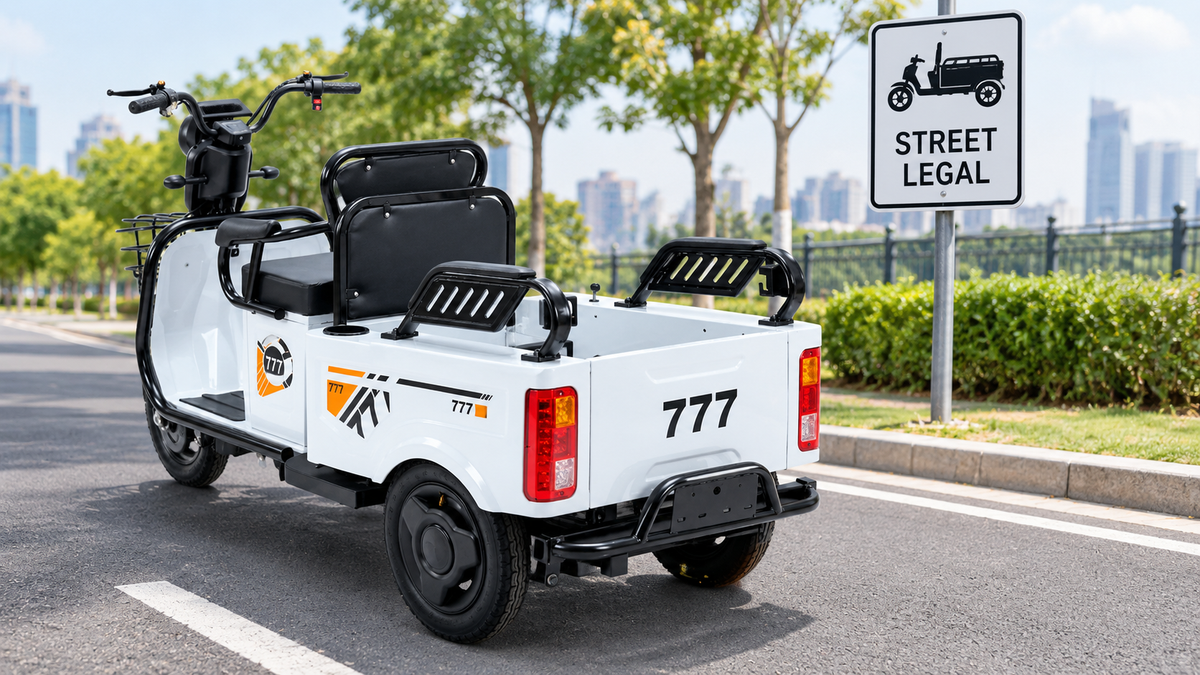
A 3-wheel electric tricycle can be legal to operate on public roads, but you cannot determine that from the number of wheels alone. The motor power, speed, pedals, vehicle design, and the laws where you ride all matter.
There is also an important distinction that gets missed in many discussions about electric tricycles: a three-wheel electric vehicle is not automatically an e-bike.
Under the federal definition of a low-speed electric bicycle, the vehicle must have two or three wheels, fully operable pedals, an electric motor of less than 750 watts, and a motor-only maximum speed of less than 20 mph under the specified federal test.
That means a 3-wheel electric vehicle with 500W of power and a 20 MPH top speed still cannot be classified as a federal low-speed electric bicycle based on those two specifications alone.
A 3-Wheel Electric Vehicle Is Not Automatically an E-Bike
Three wheels are allowed under the federal definition of a low-speed electric bicycle, so having a third wheel does not automatically disqualify a vehicle from being an e-bike. The federal definition specifically includes two- and three-wheeled vehicles.
But wheel count is only one part of the definition.
The vehicle also needs fully operable pedals.
That requirement appears in the federal definition and in many state e-bike laws. West Virginia, for example, defines an electric bicycle as a two- or three-wheeled vehicle with fully operable pedals and an electric motor of fewer than 750 watts. Tennessee uses a similar structure and also requires the vehicle to fit one of its three e-bike classes.
So the legal question is not simply:
"Does it have three wheels?"
It is:
"Does this particular three-wheel vehicle meet the definition of an electric bicycle where it will be operated?"
Why Pedals Matter More Than the Number of Wheels
This is one of the easiest details to overlook when comparing electric tricycles.
The federal low-speed electric bicycle definition requires fully operable pedals.
That means two vehicles can look very similar while falling into different legal categories.
For example:
Vehicle A
- 3 wheels
- 500W motor
- less than 20 MPH under the applicable test
- fully operable pedals
This can potentially fit the federal low-speed electric bicycle definition, assuming the other applicable requirements are satisfied.
Vehicle B
- 3 wheels
- 500W motor
- 20 MPH top speed
- no pedals
You cannot simply call Vehicle B an e-bike because the motor and speed numbers look similar.
NHTSA has addressed this distinction directly. In one official interpretation, NHTSA explained that vehicles without pedals would not be classified as low-speed electric bicycles under 15 U.S.C. §2085. At the same time, NHTSA noted that a vehicle failing to qualify as a low-speed electric bicycle does not automatically become a federal motor vehicle in every situation. State laws can still apply.
What Do 500W and 20 MPH Actually Tell You?
Motor power and top speed are useful specifications, but they are not a complete answer to the street-legal question.
A 500W motor is below the federal low-speed e-bike definition's 750W threshold. But the federal definition also requires fully operable pedals and uses a specific test for motor-only speed.
So this reasoning is incomplete:
500W + 20 MPH = street legal e-bike
A more accurate way to look at it is:
motor power + speed + pedals + vehicle design + applicable state law = classification and operating requirements
State laws can also add their own details. Some states explicitly define e-bikes as two- or three-wheeled vehicles with fully operable pedals, while others have additional requirements involving wheel size, seats, classes, labeling, or operating locations.
What If a 3-Wheel Electric Tricycle Has No Pedals?
If an electric tricycle has no fully operable pedals, you should not automatically classify it as a low-speed electric bicycle under the federal definition.
The federal definition requires fully operable pedals.
That does not mean every no-pedal electric tricycle is automatically a motorcycle.
NHTSA has previously explained that certain low-speed two- or three-wheeled electric vehicles without pedals did not meet the statutory low-speed electric bicycle definition, but also were not necessarily treated as motor vehicles under federal law based solely on that fact and their described characteristics. NHTSA also emphasized that such vehicles remain subject to state laws.
This creates an important legal distinction:
Not an e-bike does not automatically mean motorcycle.
The next question becomes:
What vehicle category does the state where you ride assign to it?
That classification can determine whether title, registration, licensing, insurance, equipment, or other requirements apply.
Does a No-Pedal Electric Tricycle Need Registration?
There is no single nationwide answer for every no-pedal electric tricycle.
Registration requirements depend on the vehicle's legal classification and the jurisdiction where it is operated.
Some state e-bike statutes specifically exclude qualifying electric bicycles from motor-vehicle registration requirements. Tennessee, for example, states that an electric bicycle meeting its statutory definition is not subject to requirements applicable to motor vehicles, including titling and registration.
But that does not mean a different type of electric tricycle without pedals automatically receives the same treatment.
Does It Need a Driver's License?
Again, the answer depends on classification and state law.
If a vehicle qualifies as an electric bicycle under the applicable state law, it may be treated differently from a motor vehicle. But a no-pedal electric tricycle should not automatically inherit the same treatment simply because it has a low-power electric motor.
California provides a good example of why the categories matter. California separately defines electric bicycles and also has other categories for motorized bicycles and three-wheeled motor-driven vehicles. The California Highway Patrol explains that different categories can have different driver's-license and helmet requirements.
What About Title, VIN, and Federal Vehicle Requirements?
This becomes especially important when an electric tricycle is designed more like a small utility vehicle than a conventional bicycle.
Pennsylvania provides a current example of why vehicle classification can become a practical issue. In a 2026 bulletin, PennDOT instructed agents not to issue on-road title or registration for certain electric cargo tricycle trucks that were not eligible for those requirements, and directed agents to check the NHTSA VIN decoder when determining whether a vehicle was built for on-road use.
For some electric cargo vehicles, road legality can involve vehicle-title, VIN, and federal vehicle-compliance questions that do not arise when dealing with a conventional bicycle.
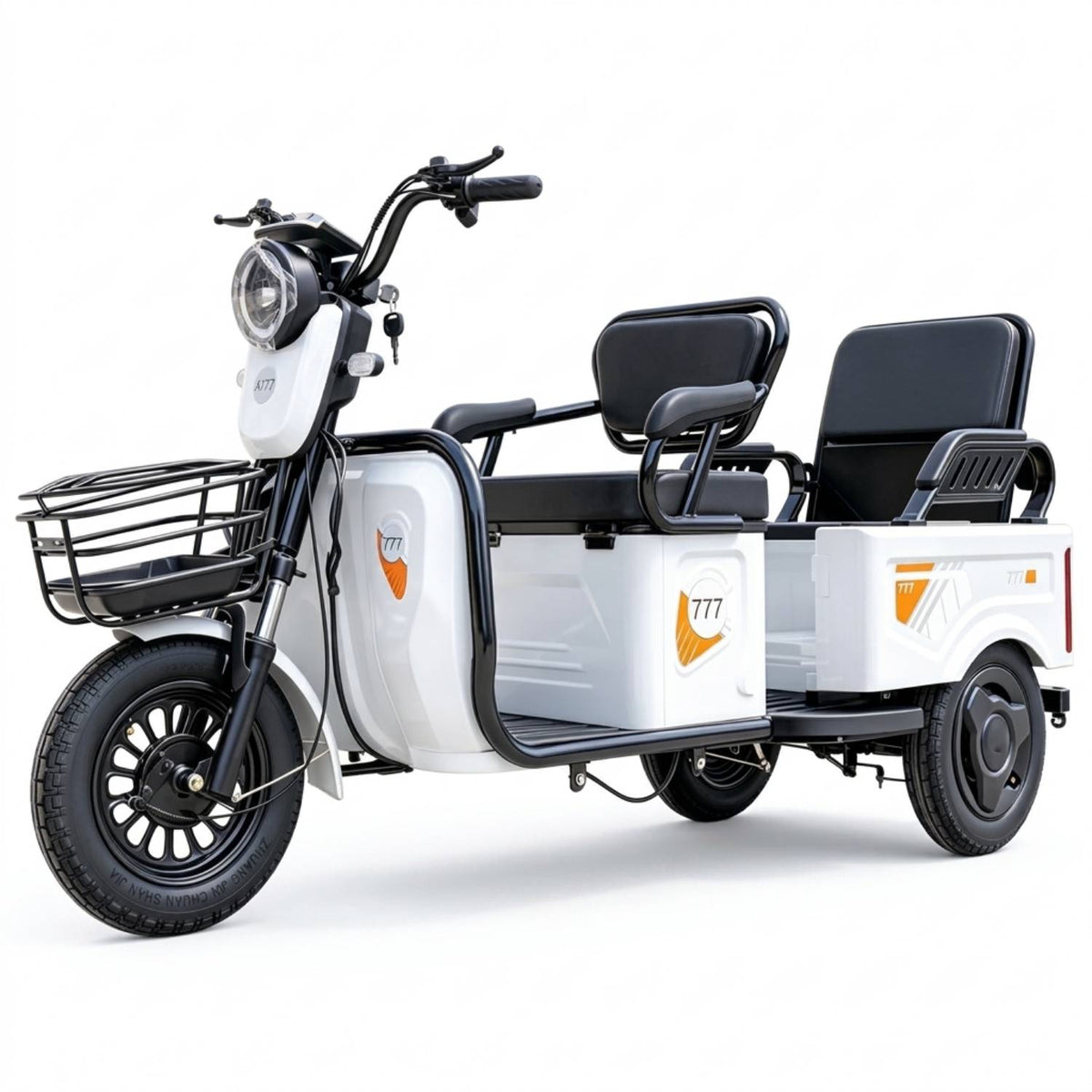
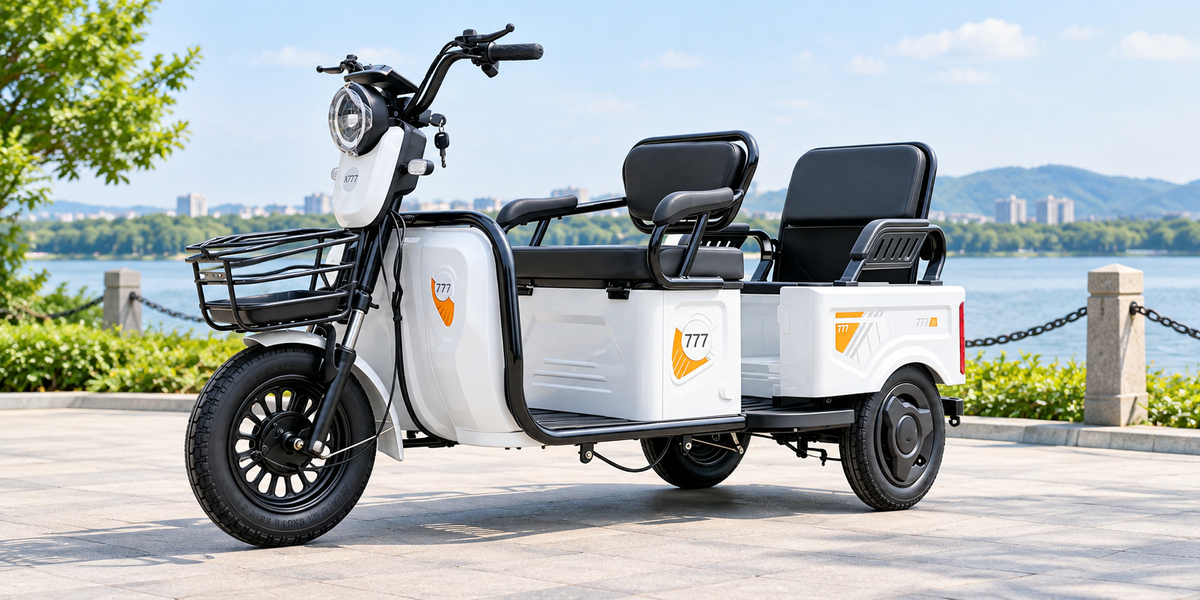
Using the GIYI Electric Cargo Tricycle as a Real-World Example
The GIYI Electric Cargo Tricycle illustrates why the specifications need to be considered together.
The product is listed as a 3-wheel electric cargo tricycle with:
- 500W electric motor
- 20 MPH top speed
- 48V 20Ah lead-acid battery
- up to 31-mile claimed range
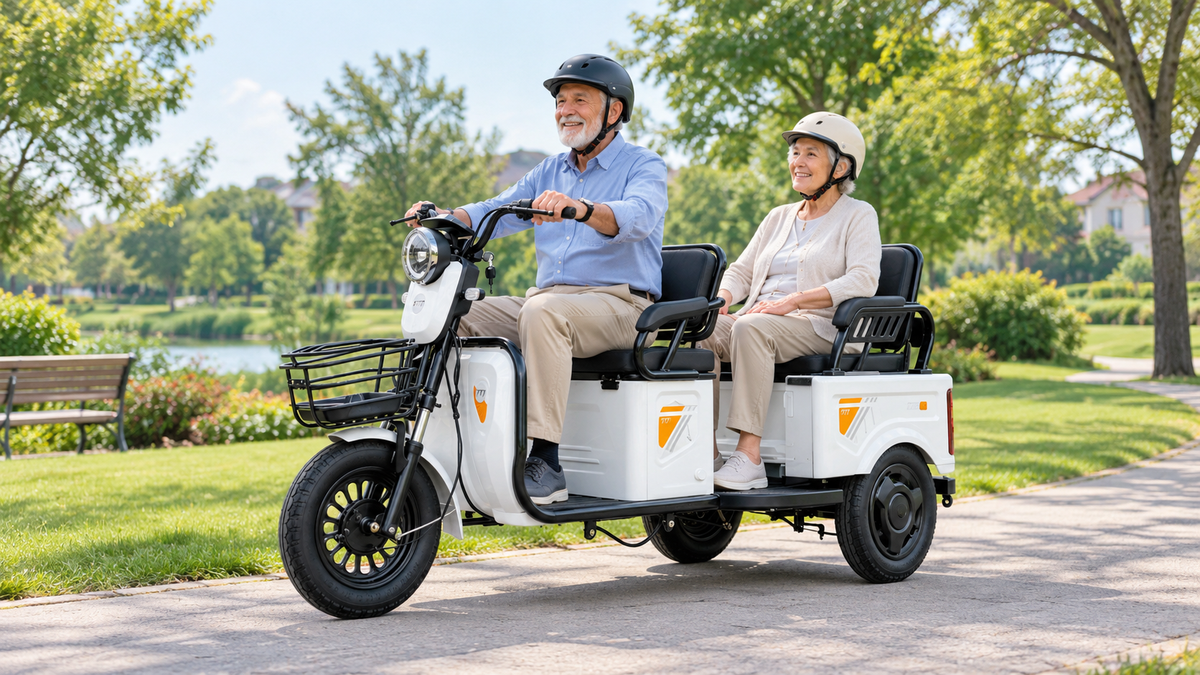
- seating for 2 passengers plus cargo
- convertible rear passenger/cargo seat
- front basket
- rear cargo box
- front and rear drum brakes
- LED headlight
- rear tail light
- turn signals
- horn
- torque-activated control
- no pedals
- no throttle
The no-pedal specification is particularly important for the legality question.
The product has the 3-wheel configuration, 500W motor, and 20 MPH advertised top speed that appear frequently in discussions about e-bikes. But its product specifications also state that it has no pedals.
Because the federal low-speed electric bicycle definition requires fully operable pedals, the product should not simply be labeled a federal low-speed e-bike based on its wheel count, motor power, and advertised speed.
That does not by itself establish that the vehicle is prohibited from public-road use. It means the road-use question needs to be answered using the vehicle classification and laws applicable in the state and locality where the tricycle will be operated.
Does a 3-Wheel Electric Cargo Tricycle Automatically Become a Motorcycle?
Different legal categories exist between a conventional bicycle and a motorcycle, and the applicable state law determines how a particular vehicle is treated.
NHTSA's own interpretation is useful here because it shows that a vehicle that does not meet the low-speed electric bicycle definition is not necessarily classified as a federal motor vehicle solely because it lacks pedals. The vehicle's characteristics and intended use matter.
So the correct sequence is:
Check whether it qualifies as an e-bike → if not, determine the applicable vehicle category → then check the requirements for that category.
What About Bike Lanes, Bike Paths, and Sidewalks?
Being permitted on a public road does not automatically mean an electric tricycle can be used everywhere a bicycle can go.
Rules can differ for:
- Public streets
- Bike lanes
- Bike paths
- Multi-use paths
- Sidewalks
- Local trails
If a vehicle is legally classified as an e-bike, the state may give it bicycle rights and impose e-bike-specific restrictions. If it falls into another vehicle category, completely different access rules may apply.
How to Check a 3-Wheel Electric Tricycle Before Riding It on the Street
Instead of starting with the product name, check the vehicle in this order.
1. Does it have fully operable pedals?
If the answer is no, do not automatically classify it as a federal low-speed electric bicycle.
2. What is the motor rating?
A 500W motor is relevant, but motor power alone does not establish the vehicle's legal category.
3. What is the actual motor-powered speed?
Do not rely only on a marketing phrase such as "20 MPH."
Check how the manufacturer defines the vehicle's maximum speed and compare that information with the test or speed standard used by the applicable law.
4. Does the vehicle have a defined e-bike class?
Do not assume Class 1, Class 2, or Class 3 simply because the vehicle has an electric motor.
Those classifications generally describe electric bicycles that already meet the underlying definition, including the pedal requirement in many state statutes.
5. What vehicle category does your state use for it?
This is particularly important for a no-pedal electric cargo tricycle.
6. Does the state require title or registration?
Check the rules for the actual vehicle category rather than searching only for e-bike registration.
7. Is a VIN required?
If the vehicle is treated as a motor vehicle or another regulated road vehicle, VIN and federal compliance requirements may become relevant.
8. Check local road and path restrictions
Even after determining the state classification, check the specific local rules for sidewalks, bike paths, trails, and other facilities.
So, Are 3-Wheel Electric Tricycles Street Legal?
Some are, but there is no single yes-or-no rule for every three-wheel electric tricycle.
A three-wheel vehicle can fit the federal low-speed electric bicycle definition, but the federal definition requires fully operable pedals along with the applicable motor and speed characteristics.
For a three-wheel electric vehicle with no pedals, the analysis changes. It should not automatically be called an e-bike, but it also should not automatically be called a motorcycle. The applicable state and local vehicle classifications determine what requirements apply. NHTSA's published interpretation illustrates this distinction.
For an electric cargo tricycle such as the GIYI model, the useful specifications to start with are its 3-wheel configuration, 500W motor, 20 MPH top speed, and no-pedal design. Those specifications help identify the legal question, but they do not by themselves establish nationwide street legality.
The safest way to answer the question for a specific vehicle is therefore:
Identify the vehicle's actual configuration → determine whether it meets your state's e-bike definition → if it does not, identify the applicable vehicle category → then check road, registration, licensing, and local-use requirements for that category.
FAQ
Are 3-wheel electric tricycles street legal?
Some can be, but legality depends on the vehicle's specifications and the laws of the state and locality where it will be operated.
Does a 3-wheel e-bike have to have pedals?
Under the federal definition of a low-speed electric bicycle, yes. The vehicle must have fully operable pedals.
Is a 500W electric tricycle automatically street legal?
No. A 500W motor alone does not establish street legality.
Is a 20 MPH electric tricycle automatically an e-bike?
No. Motor speed is only one part of the classification. The federal low-speed e-bike definition also requires fully operable pedals.
Can a no-pedal electric tricycle be an e-bike?
It should not automatically be treated as a federal low-speed electric bicycle because the federal definition requires fully operable pedals. State law may have its own vehicle classifications and requirements.
Does a no-pedal electric tricycle automatically count as a motorcycle?
No. The absence of pedals alone does not establish that classification. The applicable vehicle definition and state law must be examined.
Does an electric cargo tricycle need registration?
It depends on its legal classification and jurisdiction. Do not assume that every electric cargo tricycle follows the registration rules for an e-bike.
Can an electric cargo tricycle ride on bike paths?
Not automatically. Path access can depend on vehicle classification, state law, local rules, and the specific path.
Can a 3-wheel electric tricycle ride on sidewalks?
That depends on the applicable local and state rules. Street legality does not automatically establish sidewalk access.
What should I check before buying an electric cargo tricycle for road use?
Check the vehicle's pedals, motor rating, actual speed specification, legal classification, title and registration requirements, and the road and path rules where you intend to ride.


Leave a comment
This site is protected by hCaptcha and the hCaptcha Privacy Policy and Terms of Service apply.