


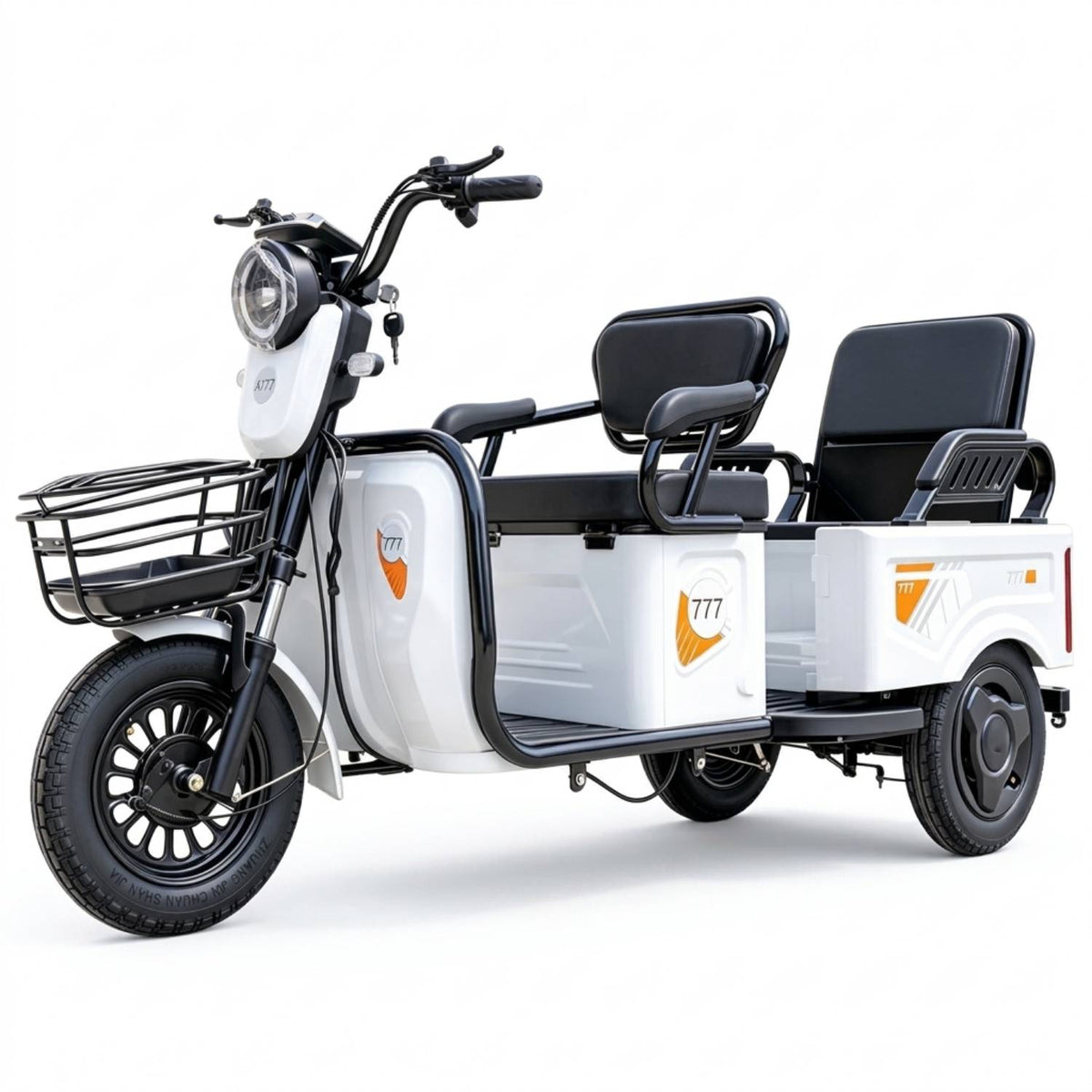

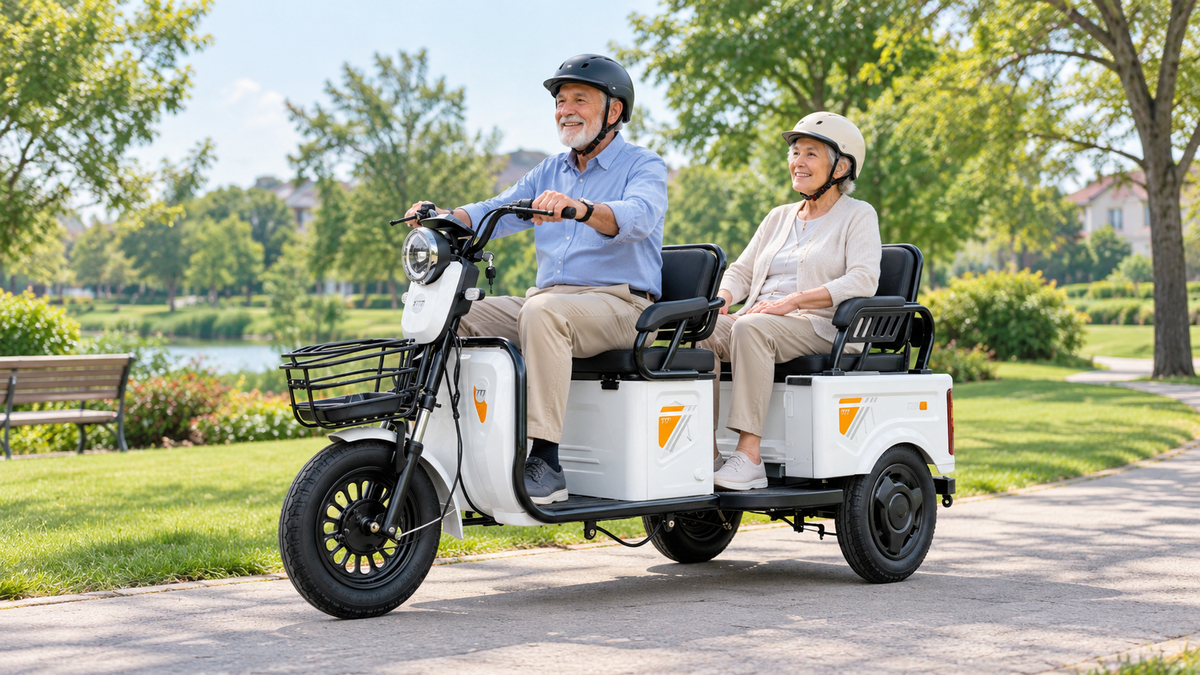
GIYI believes that for seniors, an electric tricycle is safer than a two-wheeled bicycle, because a trike stays upright when stopped or moving at low speeds and won't tip over. An electric motor also makes riding much less physically demanding for older riders. One important caution: there is a risk of tipping over when taking sharp turns too fast.
At GIYI, we sell electric tricycles for everyday errands and short local trips. Here is what to know about safety before you choose one. Whether a trike is safe for you depends on three things:
- The match: your health, balance, strength, and where you plan to ride.
- The trike: its brakes, weight, power delivery, and battery.
- The habits: above all, how you take corners and slopes in your first few weeks.
Is an E-Trike Right for You?
| Your situation | Typical fit | What to do first |
|---|---|---|
| Nervous about balancing on two wheels, no major medical issues | Usually a good fit | Practice in an empty lot before real roads |
| Knee, hip, or back pain; arthritis | Often a good fit | Check seat fit and ease of getting on and off; ask your doctor or physical therapist |
| Poor balance, past falls, Parkinson's, MS, or stroke recovery | Possible, with assessment | Get a therapist's input; consider an adaptive or recumbent trike |
| Dizziness, fainting, uncontrolled heart rhythm or seizures | Ask your doctor first | Don't ride until cleared |
| Memory or judgment problems affecting road safety | Often not safe on public roads | Supervised riding on quiet paths, or another option |
| Taking blood thinners | Can ride, but a fall is more dangerous | Helmet every ride; avoid busy traffic |
Why Trikes Feel Safer Than Two-Wheel Bikes
- No balancing at stops or low speed.
- The motor reduces fatigue. Tired riders make more mistakes.
- A relaxed, upright seat puts less strain on wrists, back, and neck.
These advantages apply at the start, at the stop, and at slow speed. In turns and on slopes, a trike behaves differently from a bike, and that is where most of the real risk lies.
The Real Risks
1. Tipping in turns
A trike can't lean into a corner the way a bike does. Turn too fast and the inside wheel can lift, and the trike can roll. The risk rises with:
- Higher speed into the turn and a tighter turning radius
- A higher center of gravity
- Turning on a downhill slope or riding across a side slope
- Sudden steering or panic reactions
Design helps, but nothing makes tipping impossible. Recumbent trikes sit low and are harder to tip than upright ones.
2. Weight and size
E-trikes are heavier and wider than bicycles, and some models weigh 90 lb or more. That means a wider turning circle, a longer stopping distance, and no easy lifting into a car.
3. A fall is still a fall
We strongly recommend that seniors always wear a helmet when riding an electric tricycle. A study of electric bikes by the Technical University of Munich found that nearly all head injuries occurred among riders who were not wearing helmets.
4. Unexpected power
Sudden surges destabilize a trike, especially at low speed or in a turn. For seniors, smooth, predictable power matters more than quick acceleration.
5. Braking, hills, and visibility
Downhill stretches add speed. Parking on a slope can let a trike roll. Trikes are low and wide, so drivers may not see you, and you may misjudge the width when passing parked cars.
6. Medical events
Dizziness, low blood pressure, or sudden fatigue can strike on any ride.
Balance Issues and Disabilities
Balance. A trike removes the need to balance at a standstill and at low speed. It doesn't fix poor trunk control, slow reactions, or dizziness.
Disabilities. Cycling UK notes that for many disabled riders the biggest barriers are stability, confidence, and the physical demand of starting, stopping, and balancing.
Our honest advice: our Electric Cargo Tricycle is built as a passenger-and-cargo trike, not as an adaptive model.
What to Look For in a Senior-Friendly Trike
| Feature | Why it matters | What to check |
|---|---|---|
| Easy mounting | Safer with limited hip or knee flexibility | Low entry; you can step on without swinging a leg |
| Brakes you can use | Stopping power matters on a heavy vehicle | Firm, even braking under load; levers within easy reach |
| Parking brake | Prevents rolling on slopes | Ask whether it's included |
| Smooth power | Avoids lurching starts | Test starts and low-speed control |
| Speed limit | Keeps you in your comfort zone | A 20 mph cap is plenty for most senior riders |
| Low, stable build | Reduces tipping | Low seat, low-mounted weight, stable stance |
| Seat support | Comfort and control | Check seat size and support against your needs |
| Lights and signals | Drivers can see you | Headlight, tail light, turn signals, horn |
| Load rating | Frame strength | Rated load comfortably above you plus cargo |
If a feature matters to you and it isn't on the product page, contact our team before you order.
How our Electric Cargo Tricycle measures up
Here are the facts for our Electric Cargo Tricycle, straight from its specification sheet:
- Speed: 20 mph top speed
- Motor: 500W AC motor
- Control: torque-activated, with no pedals and no throttle
- Brakes: front and rear drum brakes
- Lighting: front LED headlight, rear tail light, turn signals, horn
- Weight and size: vehicle weight 178.6 lbs; 76.8" L × 27.6" W × 43.3" H; not a folding model
- Load: maximum load 330.7 lbs; front basket 22 lbs; rear cargo box 33.1 lbs
- Battery and range: 48V 20Ah lead-acid battery; up to 31 miles per charge; 8–9 hours to charge
At 178.6 lbs, this is a trike you park and ride, not one you lift into a trunk. At 27.6 inches wide, it may fit through many gates and doorways, and like any three-wheeler it rewards slow, smooth turning.
How to Ride Safely: Your First 30 Days
Before buying: try a trike, and bring someone who will watch honestly. Make sure your feet reach the ground, you can reach the controls, and you can get on and off comfortably.
Week 1, empty parking lot: practice starting, stopping, and slow turns in both directions. Practice braking gently, then more firmly.
Week 2, quiet streets: add gentle slopes, small bumps, and a load such as groceries.
Weeks 3–4, real routes: choose low-traffic roads in daylight and dry weather. Increase distance gradually.
The safe cornering sequence
- Look ahead and see the turn coming.
- Slow down before the turn, not during it.
- Ease off the power as you enter.
- Take a wider, smoother arc instead of a sharp pivot.
- Stay seated and centered; avoid sudden weight shifts.
- Avoid hard braking or acceleration in mid-turn.
Everyday habits
- Wear a helmet on every ride, even short ones.
- Avoid turning on downhill slopes and riding across steep side slopes.
- Brake early on descents.
- Keep cargo low and evenly balanced.
- Check tires, brakes, and charge before each ride.
- Rest before you're tired.
Battery and Charging Safety
Battery-fire warnings from CPSC and fire-safety groups focus mainly on lithium-ion packs. CPSC figures cited by IAEI Magazine count 208 micromobility fire or overheating incidents between January 2021 and November 2022, with at least 19 deaths. That covers e-bikes, scooters, and similar devices, not trikes alone.
Our Electric Cargo Tricycle uses a 48V 20Ah lead-acid battery. Whatever the battery type, the habits are the same:
- Use only the charger supplied with your vehicle.
- Charge in a ventilated area, away from flammable materials.
- Don't leave it charging unattended for long periods.
- Stop using any battery that is swollen, hot, leaking, or damaged.
- Never modify the battery or charger.
Rules of the Road
Rules vary by state and country. In the U.S., federal product-safety rules define a "low-speed electric bicycle" as a two- or three-wheeled vehicle with fully operable pedals, a motor under 750 watts, and a motor-only top speed under 20 mph. Many states add Class 1, 2, and 3 categories, and Class 3 often carries age limits.
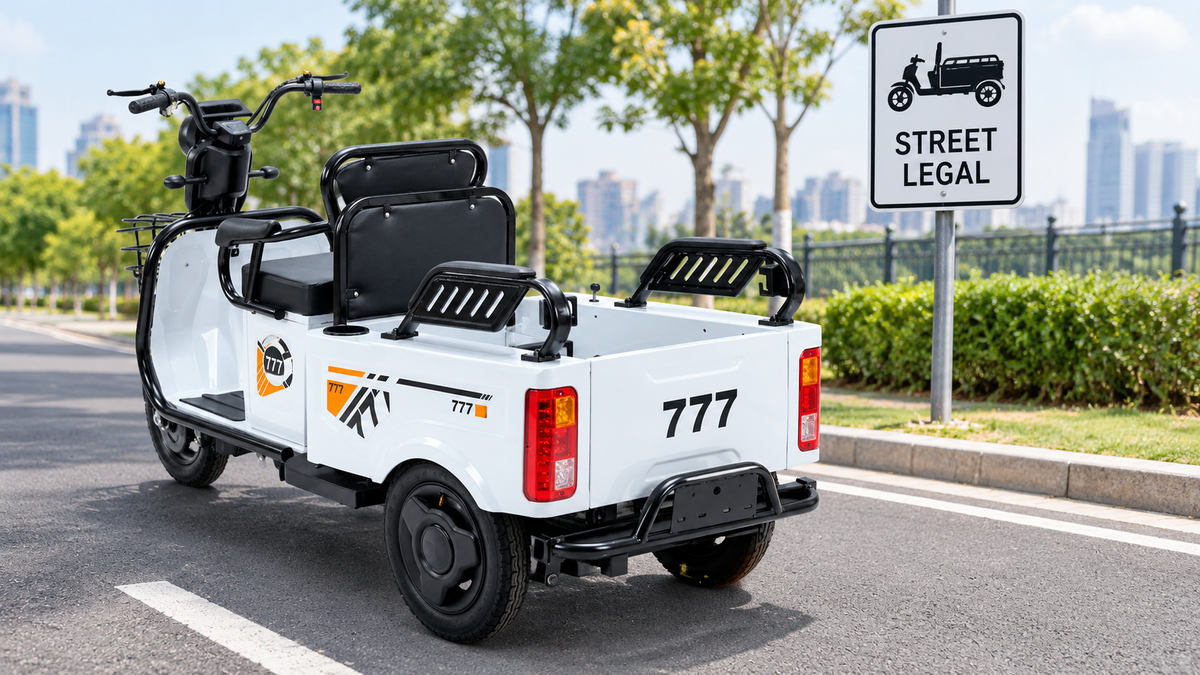
Vehicles without pedals may be classified differently. Our Electric Cargo Tricycle is designed as a low-speed personal vehicle for neighborhood, shopping, and daily local riding.
Two Adults on One Trike
A passenger changes the safety picture: a higher center of gravity, a longer braking distance, less range, and more strain on the frame and brakes. Before you buy any two-person trike, check:
- The rated load, for both riders plus cargo, not just the rear seat.
- The brakes, under a full load.
- Helmets for both people.
- Who steers. The steadier rider should.
Our 2-passenger Electric Cargo Tricycle has a convertible rear seat that switches between passenger mode and cargo mode. Its maximum load is 330.7 lbs, and that figure covers everyone and everything on board.
Enclosed Electric Tricycles
An enclosure gives you shelter from rain, wind, and sun. It isn't the same as a crash-tested car cabin. Before buying, ask for independent test evidence for the shell's crash protection, check how the vehicle is classified in your state, and find out how it handles crosswinds and heat.
E-Trike vs. E-Bike for Seniors
| E-trike | E-bike | |
|---|---|---|
| Balance at a stop | Not needed | Required |
| Cornering | Can't lean; slow down first | Leans naturally |
| Tip-over risk | Possible in fast or sharp turns | Falls if balance is lost |
| Weight and storage | Heavier, wider, harder to store | Lighter, easier |
| Tight spaces | More difficult | Easier |
| Best for | Riders who value stability | Confident cyclists who value agility |
How to Choose the Right Trike
- Fit: feet reach the ground, controls within easy reach, easy to get on and off.
- Stability: low center of gravity and a stable stance.
- Brakes: firm, even braking and easy levers.
- Power: smooth, predictable delivery.
- Weight and size: can you store it and move it?
- Real-world range: hills, wind, cargo, and passengers all reduce it.
- Support: warranty, customer service, and parts.
Red flags: vague specs for weight capacity, brakes, or battery; no safety certification for lithium batteries; unrealistic range claims; and any seller who calls a trike "impossible to tip" or "completely safe for everyone."
Browse our full range of electric tricycles and compare specifications side by side. Every GIYI electric tricycle comes with a 1-year vehicle warranty, and our support team can answer questions before you order.
FAQ
Are e-trikes safe for seniors?
For many seniors, yes, when the trike fits the rider, is in good condition, and is ridden sensibly. They remove the balance problem at low speed but can still tip in fast or sharp turns.
Can an electric trike tip over?
Yes. The most common cause is turning too fast or too tightly, especially on slopes or with uneven cargo. Slow down before the turn and keep your movements smooth.
Are e-trikes safe for seniors with disabilities?
Often, with the right model and a professional assessment. Adaptive options such as recumbent seating, hand cranks, and foot retainers exist. Trikes are not suitable where cognition, fainting, or reaction time are concerns.
Do seniors need a helmet on an e-trike?
Yes, we strongly recommend one on every ride, whatever your local law says. Older riders face higher risk from head injuries, and blood thinners can make them worse.
Do I need a license?
It depends on your state and on how your vehicle is classified. Check your local motor vehicle rules before riding on public roads.
Summary:
Match the trike to the rider, practice before real roads, slow down before every turn, and wear a helmet every time. If you're ready to compare options, start with our electric tricycle collection.



Leave a comment
This site is protected by hCaptcha and the hCaptcha Privacy Policy and Terms of Service apply.