



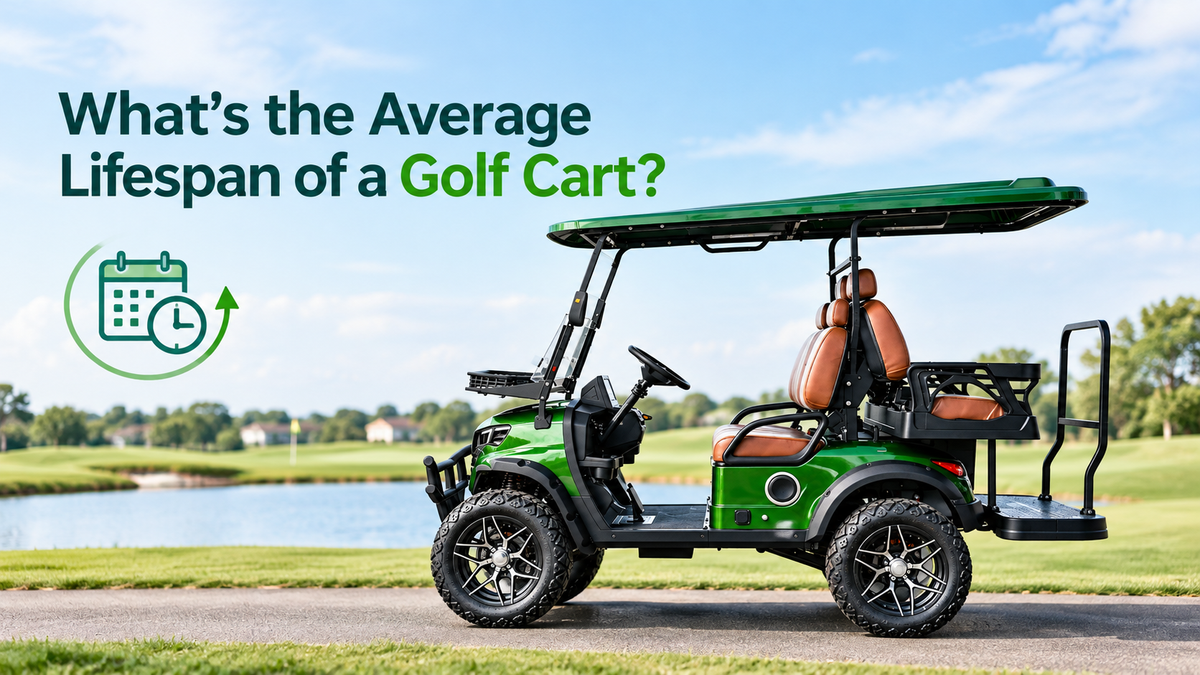
Based on GIYI real-world testing, a golf cart lasts 10 to 15 years on average, and if the battery has been replaced along the way, its service life can reach 20 years or even longer. The wide range comes down mainly to three factors: the battery pack, the frame, and the motor. Because GIYI sells electric golf carts, we want you to understand these numbers before you buy, whether you choose our carts or any other brand.
Golf Cart Lifespan at a Glance
|
What |
Typical lifespan |
What drives it |
|---|---|---|
|
Whole cart, private use, maintained |
10–15 years |
Maintenance, storage, battery care |
|
Whole cart, heavy use or neglected |
7–10 years |
Daily long runs, loads, harsh climate |
|
Whole cart, long-lived |
20+ years |
Battery replacements, rebuilt parts, dry storage |
|
Lead-acid battery set |
3–5 years |
Charging habits, watering, depth of discharge |
|
Lithium (LiFePO4) battery pack |
8–10 years (commonly quoted) |
Charge cycles, charger, temperature, BMS quality |
|
Golf course fleet cart |
About 4 years on the course |
Lease and replacement schedule, not failure |
What Actually Wears Out First
In an electric cart the battery pack wears out first; in a gas cart it is usually the engine and fuel system. Most other parts are far cheaper to fix than the cart is to replace.
Typical order of wear, fastest to slowest:
- Batteries (electric carts). Lead-acid sets are a recurring expense; lithium packs stretch that interval a lot.
- Wear parts. Tires, brake pads and cables, steering components and suspension bushings wear faster with heavy loads, hilly terrain and constant stop-and-go driving.
- Electrical components. The controller, solenoid and motor brushes age with hours of use and heat.
- Engine and drivetrain (gas carts). Spark plugs, filters, belts and the fuel system need regular service, and the engine itself may eventually need a rebuild.
- Frame and body. The slowest to go.
Our advice: judge a cart by its battery and frame, not its paint. A solid frame with a dead battery is a repair job; a rusted or cracked frame is a safety problem.
Electric vs. Gas Golf Cart Lifespan
Electric and gas carts last about the same, roughly 10 to 15 years with proper care, but they wear out in different places: electric carts spend on batteries, gas carts on engine upkeep.
|
|
Electric cart |
Gas cart |
|---|---|---|
|
Typical overall lifespan |
10–15 years |
10–15 years, often longer with good servicing |
|
Main wear item |
Battery pack |
Engine, belts, fuel system |
|
Big recurring cost |
Battery replacement (every 3–5 years for lead-acid, 8–10 for lithium) |
Engine service, and eventually a rebuild or replacement |
|
Routine upkeep |
Charging habits, watering (lead-acid), clean terminals |
Oil and filter changes, spark plugs, fresh fuel |
|
Where a lack of care hurts most |
Deeply discharged or neglected batteries |
Skipped oil changes, old fuel, dirty air filter |
Some manufacturers claim their carts can last 20 years, but there's a catch: the cart has to be maintained regularly, and an electric golf cart also needs its battery replaced periodically to get there.
Battery Lifespan: Lead-Acid vs. Lithium
A flooded lead-acid battery set typically lasts 3 to 5 years, while a lithium (LiFePO4) pack is commonly quoted at 8 to 10 years.
|
|
Flooded lead-acid |
Lithium (LiFePO4) |
|---|---|---|
|
Typical life |
3–5 years (up to 6–7 with careful care; 2–3 in rental fleets) |
8–10 years commonly quoted |
|
Charge cycles |
About 500–1,000 |
About 3,000–5,000 |
|
Maintenance |
Regular watering and terminal cleaning |
None |
|
Full charge time |
Roughly 8–10 hours |
Roughly 2–4 hours |
|
Upfront cost (48V, installed, approx. 2026 US) |
About $900–$1,900 |
About $1,800–$5,000 for a complete system |
Prices vary by voltage, capacity, brand and who installs it. The ranges above reflect retail quotes from battery sellers in 2026.
Why Lead-Acid Lifespan Varies So Much
The same set can last 2 years or 6. What matters most is how deeply you drain it before charging, whether you top up with distilled water, how clean the terminals are, and whether it sits discharged in storage.
How Long Do Lithium Golf Cart Batteries Really Last?
Plan on 8 to 10 years. Some brands advertise 10 to 20, but LiFePO4 packs have only been common in golf carts for a relatively short time, and those claims assume ideal charging and temperatures.
Cycles are not the only limit: at about four full charges a week, 3,000 cycles would last over 14 years on paper, yet real packs are quoted at 8 to 10 because heat, age and electronics wear too.
Is Lithium Worth It?
Over ten years you will typically buy two to three lead-acid sets, roughly $1,800 to $5,700 at the installed prices above, versus one lithium system at about $1,800 to $5,000. If you convert an older cart, add a lithium-compatible charger and check that the tray, wiring and controller work with the new pack; a lead-acid charger should not be used on a lithium battery.
Fleet Carts vs. Private Carts: Why 4 Years Is Not the Real Lifespan
Golf courses commonly replace their fleets every four years. That is a business decision about wear and resale value, not the point where carts die; carts kept longer simply lose value quickly and break down more often.
|
|
Fleet cart |
Private cart |
|---|---|---|
|
Typical time in service on the course |
About 4 years |
No fixed cycle; replaced when it wears out |
|
Usage pattern |
Many rounds a day, heavy loads, constant stops |
A few hours a week |
|
Battery life |
Often shorter (lead-acid sets can need replacing in 2–3 years) |
3–5 years for lead-acid, longer with careful care |
|
Total lifespan after resale |
Varies widely with prior use |
10–15 years typical |
What Counts as High Mileage for a Golf Cart?
There is no official definition of high mileage for a golf cart, and many carts have no odometer. Age, battery condition and hours of use are better measures than miles.
The simple arithmetic shows why age usually matters more than hours for a private owner:
- 1 hour a day is about 365 hours a year. Ten years adds up to roughly 3,650 hours, far below that limit.
- 5 hours a day is about 1,825 hours a year. Reaching 12,000 hours takes only around 6 to 7 years.
This roughly aligns with a lifespan of 7 to 10 years for golf carts subjected to heavy use, and 10 to 15 years for those with light use.
A Practical Way to Judge Wear
|
Level of use |
Typical profile |
What to expect |
|---|---|---|
|
Light |
Private cart, short neighborhood or weekend trips |
Longest lifespan; battery age is the main concern |
|
Moderate |
Daily errands, resort or community use |
Expect earlier battery and wear-part replacement |
|
Heavy |
Ex-fleet, rental, farm or work cart, hours every day |
Inspect suspension, brakes, steering and frame closely; budget for batteries |
How Far Can an Electric Golf Cart Go on One Charge?
Most electric golf carts cover about 15 to 35 miles on a charge with lead-acid batteries and about 25 to 40 miles or more with a 48V lithium pack. GIYI electric golf cart has a range of up to 44 kilometers.
|
Setup |
Typical range per charge |
Typical run time |
|---|---|---|
|
36V lead-acid |
About 20–25 miles |
2–3 hours |
|
48V lead-acid |
About 15–35 miles, falling as the batteries age |
2–3 hours |
|
48V lithium |
About 25–40+ miles |
4–5+ hours |
|
High-capacity 48V lithium |
Up to about 40–50 miles (advertised) |
4–5+ hours |
The lead-acid range is wide because sellers quote very different numbers and capacity fades as the pack ages. A set that gave you a full round in year one may need a midday charge by year four.
Our 4 Seater Electric Golf Cart and 2 Seater Electric Golf Cart each use a 60V 100Ah battery and are rated for up to 44 miles per charge, with a built-in charger and about 8 hours to recharge. A 60V 100Ah pack holds roughly 25% more energy than a 48V 100Ah pack, which is why that rating sits above the typical 48V figures in the table.
What Cuts Your Range
- Terrain. Steep or long hills drain a battery much faster than flat ground.
- Weight. Passengers, golf bags, cargo and accessories all add load.
- Speed and driving style. Steady driving is more efficient than hard acceleration and frequent braking.
- Tire pressure. Under-inflated tires add rolling resistance.
- Battery age and condition. Capacity declines gradually, and a weak battery in the pack drags the others down.
- Temperature. Cold weather reduces usable capacity; heat shortens battery life over time.
Signs Your Golf Cart Is Reaching the End of Its Life
The clearest sign is a pattern: shrinking range, slower hills, repeated repairs, or rust and cracks in the frame. One is usually fixable; several at once means it is time to compare repair costs against replacement.
Common Warning Signs
- Shorter range or slow hill climbing. The usual sign of worn batteries.
- A charger that runs much longer than it used to, or never finishes. Points to weak batteries or a charger problem.
- Frequent watering (lead-acid), swollen cases, leaks or heavy terminal corrosion.
- Clicking, hesitation or loss of power. Can indicate solenoid, controller or wiring faults.
- Hard starting, smoke or loss of power (gas carts). Often engine wear or fuel-system problems.
- Rust or cracks in the frame, or a sagging, noisy suspension. Structural issues are a safety concern, not a cosmetic one.
- Repairs stacking up. A different part failing every few months.
Repair or Replace? A Simple Decision Guide
|
Problem |
Usually best move |
|---|---|
|
Short range, weak hills, old batteries |
Replace the batteries. It is typically the cheapest way to bring a sound cart back to life. |
|
Worn tires, brakes, bushings, steering parts |
Repair. These are normal wear items and cost far less than a new cart. |
|
Controller or motor failure |
Get a quote first. Worth repairing on a sound, newer cart; questionable on an old one with other problems. |
|
Gas engine failure |
Compare a rebuild or replacement quote with the cart's market value. |
|
Rust or cracks in the frame |
Replace the cart. Structural damage is rarely worth repairing. |
A common rule of thumb is to think hard about replacing the cart if a single repair would cost more than about half of what the cart is worth, or if it needs a new battery set and major mechanical work at the same time.
How to Make a Golf Cart Last Longer
If You Have Lead-Acid Batteries
- Charge after every meaningful use. Avoid regularly running the pack close to empty.
- Check water levels and top up with distilled water only. Keep the plates covered, and add water after charging rather than before.
- Keep terminals clean and tight. Corrosion wastes power and damages wiring.
- Use the correct charger. A mismatched or faulty charger shortens battery life.
- Never store the cart discharged. Charge it fully before storage and recheck periodically.
If You Have Lithium Batteries
- Use the charger designed for lithium. Do not use an old lead-acid charger.
- Mind the temperature. Most lithium packs should not be charged below freezing unless they have low-temperature protection, so check your pack's specifications.
- Follow the maker's storage guidance for state of charge during long layups.
- Choose a pack with a quality battery management system (BMS) and a clear warranty.
For Every Cart
- Keep tires at the recommended pressure. It protects range and tire life.
- Inspect brakes, steering and suspension regularly, and lubricate the points your manual specifies.
- Do not overload it. Stay within the seating and cargo limits.
- Store it dry and covered, out of direct sun and standing water. This protects the frame, wiring and body.
- Wash off mud, salt and chemicals and dry the cart afterward.
If You Have a Gas Cart
- Service the engine on schedule: oil and filter, air filter, spark plug and belts.
- Use fresh fuel, and use a stabilizer or drain the tank for long storage.
- Fix small leaks and rough running early. They tend to get expensive when ignored.
If You Own a GIYI Golf Cart
Our carts are built around a 60V 100Ah battery and a built-in charger, so there is no separate charger to buy for normal charging. Our maintenance advice is simple: keep the battery terminals clean, the tires properly inflated, and the cart clean and dry. If you have a specific question, contact our team.
Buying a Used Golf Cart: A Lifespan Checklist
When you buy used, battery age and the cart's history tell you more than the model year. Run through these checks before agreeing on a price.
- Confirm the model year. Check the serial number with the manufacturer or a dealer rather than relying on the seller's word.
- Ask how old the batteries are and what charger comes with the cart. Lead-acid sets past 3 to 4 years should be priced as if you will replace them soon.
- Find out where the cart came from. Ex-fleet carts are usually heavily used; private carts are often gentler.
- Inspect the frame. Look for rust, cracks, and previous weld or bend repairs, especially under the battery tray and around suspension mounts.
- Check suspension, brakes and steering. Look for play in the steering, uneven tire wear, a spongy or slow brake and squeaks or clunks over bumps.
- Test drive with weight and a hill. A tired battery or motor shows up quickly under load.
- Test the range realistically. Start from a full charge and drive for a while, then see how much the battery gauge drops.
- Look at the wiring and battery area. Heavy corrosion, melted insulation or leaking cases are warning signs.
- For gas carts: do a cold start, check for smoke and oil leaks, and listen for knocking or uneven running.
- Ask for maintenance records, and budget for a battery replacement if the pack is old.
Between two similar carts, the one with newer batteries and documented care is usually the better buy. If you would rather start fresh with a new battery and a warranty, browse our Golf Carts collection.
Golf Cart Lifespan FAQ
What's the average lifespan of a golf cart in 2026?
The answer is still 10 to 15 years with good care. What has changed is the battery: lithium packs are more common and prices have been falling, which can push the number of battery replacements down over a cart's life.
How long do electric golf carts last on one charge?
Expect about 2 to 3 hours of run time on lead-acid batteries and about 4 to 5 hours or more on lithium, depending on terrain, load and battery age.
How many miles can a golf cart go on one charge?
Roughly 15 to 35 miles on lead-acid and 25 to 40 miles or more on a 48V lithium pack. High-capacity lithium packs are advertised at up to about 50 miles, but real-world range depends on hills, weight, speed and battery condition. Our GIYI carts, which use a 60V 100Ah battery, are rated for up to 44 miles per charge.
How long do gas golf carts last?
Typically 10 to 15 years, and sometimes up to 20 with regular servicing. The engine, belts and fuel system need attention over time, so keep up with oil changes and fuel care.
Is it worth replacing the batteries in an old golf cart?
Usually yes, if the frame, suspension and motor are sound. A new battery set is far cheaper than a new cart. If the frame is rusted or cracked, or several major repairs are due at once, replacing the cart makes more sense.
Can a golf cart last 20 years?
Yes. Many do, but it takes consistent maintenance, battery replacements along the way and dry storage. Over 20 years, expect at least two battery sets, and three or more if you stay with lead-acid.
What warranty comes with a GIYI golf cart?
Every GIYI golf cart includes a 1-year warranty from the date of delivery, covering the vehicle and the battery system. It does not cover misuse, accidents, unauthorized modifications or normal wear and tear. Please check our warranty policy!
The Bottom Line
Plan on 10 to 15 years from a golf cart that is looked after, and expect the battery to be the part you replace most often: every 3 to 5 years with lead-acid, or about every 8 to 10 years with lithium.


Leave a comment
This site is protected by hCaptcha and the hCaptcha Privacy Policy and Terms of Service apply.