



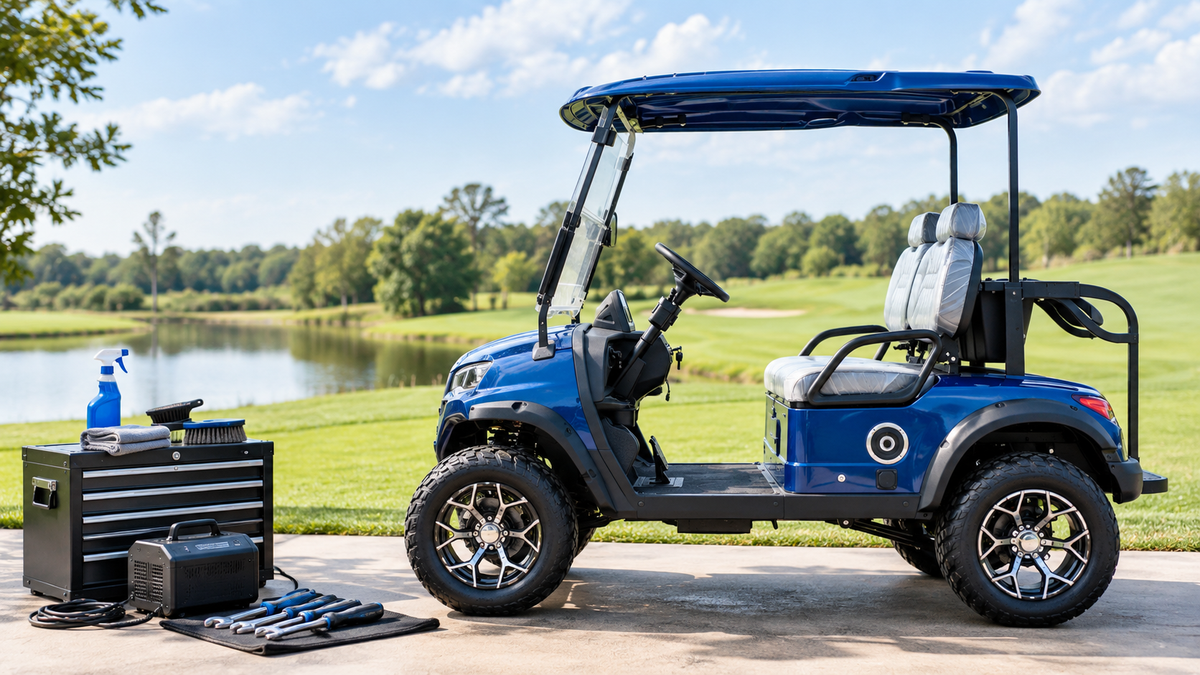
At GIYI, we build electric golf carts, so we know better than anyone how to maintain and care for them. To extend the lifespan of your golf cart, there are 5 key things you need to know. This guide covers each one, including maintenance schedules, test data, troubleshooting tables, and real-world costs.
Charge after every outing. If you have flooded lead-acid batteries, check the water every 2 to 4 weeks with distilled water only. Keep terminals clean and tight. Check tire pressure monthly. Test the brakes.
Step 1: Find Out Which Battery You Have
|
Battery type |
How to recognize it |
Needs water? |
Typical lifespan* |
|---|---|---|---|
|
Flooded lead-acid (FLA) |
Removable caps on top; 4 to 8 heavy batteries (6V, 8V or 12V) wired in series |
Yes |
About 3 to 5 years |
|
AGM or gel (sealed lead-acid) |
Sealed case, no caps |
No |
Varies |
|
Lithium (usually LiFePO4) |
One or two compact packs, much lighter, often with a display or app |
No |
Often 5 to 10 years or more |
Own a GIYI cart? Our 4 Seater Electric Golf Cart and 2 Seater Electric Golf Cart both use 60V battery systems with a dashboard display. On the 4 Seater, the display shows battery level and mileage, so you can check charge without a multimeter.
Your Maintenance Schedule at a Glance
|
When |
What to do |
|---|---|
|
After every outing |
Plug in the charger and let it finish. Glance at tires and look for leaks or loose parts. |
|
Every 2 to 4 weeks (flooded lead-acid only) |
Check electrolyte level; add distilled water if low. |
|
Monthly |
Check tire pressure (cold), test brakes and parking brake, inspect charger cord and charging port, check that battery cables are tight. |
|
Every 3 months |
Clean battery terminals and battery tops, inspect wiring for rubbed or cracked insulation, check steering for looseness. |
|
Every 6 months |
Grease the steering and suspension fittings your manual lists. |
|
Yearly |
Full inspection. Check rear axle oil per manual. |
Battery Maintenance
Charging Habits for Lead-Acid Batteries
- Charge after every outing. Leaving lead-acid batteries discharged causes sulfation, a plate buildup that permanently reduces capacity.
- Avoid running them flat.
- Let the charger finish its cycle and use the charger made for your pack.
- Charge in a ventilated area. Lead-acid batteries release hydrogen gas while charging, so keep sparks and flames away.
- Never charge a frozen battery. Let it warm to room temperature first.
- Equalizing: use your charger's equalize mode only if the charger and battery maker recommend it, and never on AGM, gel or lithium unless the manufacturer says so.
Can you leave the charger plugged in?With a modern automatic charger that shuts off or switches to maintenance mode, staying plugged in is generally acceptable for flooded batteries, but batteries on a charger still lose water, so keep checking the level.
How to Water Flooded Lead-Acid Batteries
- Charge first, unless the plates are exposed. Batteries expand while charging, so topping up a discharged battery can make it overflow.
- Wear safety glasses and gloves. The liquid is dilute sulfuric acid.
- Open the caps and look in each cell.
- Use distilled or demineralized water only. Tap water contains minerals that shorten battery life.
- Fill to the level indicator or the bottom of the fill well, per the battery maker's instructions. Overfilling makes acid leak during charging and corrodes the tray, cables and frame.
- Close the caps and wipe up spills. Neutralize acid on surfaces with baking soda and water.
How to Clean Battery Terminals
- Turn the key off, unplug the charger and remove jewelry.
- Disconnect the main negative cable first, as your manual directs.
- Brush a baking soda and water mix onto corrosion; it fizzes as it neutralizes the acid.
- Scrub terminals and cable ends with a wire brush until the metal is bright.
- Wipe with a damp cloth without letting water into the cells, then dry thoroughly.
- Reconnect snug, not over-tightened, and apply terminal protectant or dielectric grease. Reconnect the main negative last.
How to Test Your Batteries
1. Resting voltage (multimeter). Fully charge the pack, then let it rest at least 12 hours with no driving or charging. Approximate pack values for flooded lead-acid at room temperature:
|
State of charge |
36V pack (six 6V batteries) |
48V pack (eight 6V batteries) |
|---|---|---|
|
100% |
about 38.2V |
about 51.0V |
|
75% |
about 37.3V |
about 49.8V |
|
50% |
about 36.3V |
about 48.4V |
|
25% |
about 35.2V |
about 47.0V |
For other voltages, a full 6V battery rests at about 6.37V. These numbers apply to flooded lead-acid only. Temperature and brand shift them, and voltage is not a reliable fuel gauge for lithium, whose voltage curve is very flat.
2. Specific gravity (hydrometer, flooded batteries only). A fully charged cell typically reads around 1.265 to 1.285.
3. Load test. This shows real health, because a battery can read well at rest and still collapse under load.
Lithium (LiFePO4) Battery Care
Lithium needs no watering, equalizing or terminal cleaning, but it isn't zero maintenance.
- Use the charger designed for the pack. A lead-acid charger is often unsuitable for lithium, so budget for a new charger if you convert.
- Don't charge below freezing (about 32°F / 0°C) unless the pack has low-temperature protection.
- Leave the BMS alone. The battery management system guards against overcharge and deep discharge.
- For months-long storage, follow the maker's guidance, which varies: some makers recommend a partial charge, others a full one.
- Stop using the pack and contact the manufacturer if you see swelling, unusual heat, a burning smell or error messages.
When to Replace the Batteries
Expect replacement soon if you see:
- Range dropping noticeably even after a full charge
- Slow acceleration, especially uphill
- One battery or cell testing well below the rest
- A pack that won't hold voltage after resting
- A swollen or cracked case
Charger and Charging Port
Charger problems look like battery problems, so check these first.
- Inspect the cord and plug for cuts, kinks and burn marks.
- Check the cart's charging receptacle for dirt, bent pins, discoloration or melting.
- Push the plug in fully. A partly seated plug is a common reason a charger won't start.
Tires, Brakes, Steering and Suspension
Tires. Under-inflated tires cut range and wear unevenly. Check pressure monthly with cold tires, using the figure on the sidewall and in your manual.
Brakes. Many carts use rear drum brakes worked by cables, while some newer models use other systems, so check your manual.
Steering and suspension. Steering should feel smooth with little free play. If the cart pulls to one side, check tire pressure first, then alignment.
Motor, Controller and Wiring
- Controller: keep it clean and dry, and don't spray it with water.
- Motor: listen for grinding, whining or squealing. Older DC motors have brushes that wear, while many newer carts use brushless AC motors.
- Wiring and connectors: look for chafed insulation, loose connectors and warm spots. A loose connection causes resistance, heat and power loss.
- Rear axle: check the oil level at the interval in your manual.
How to Wash an Electric Golf Cart
- Turn the key off and unplug the charger.
- Use a garden hose, mild soap and a soft sponge. Harsh solvents can damage paint and plastic.
- Skip the pressure washer near the battery compartment, controller, motor, charging port and wiring. High-pressure water can force moisture into electrical parts.
- Dry the cart and wipe the battery tops dry, since wet, dirty tops can leak current across the surface.
Storing Your Cart
Flooded lead-acid:
- Charge fully. If the plates are exposed, add distilled water to cover them before charging, then top up to the proper level afterward.
- Clean the batteries and terminals.
- Turn the key off. If your cart has a Tow/Run switch, set it as your manual directs.
- Disconnect the main negative cable, or use a maintenance-mode charger.
- If the pack is disconnected, check and recharge it at least every 30 days. A discharged lead-acid battery can freeze in cold weather.
- Store the cart in a cool, dry, covered space with tires at the correct pressure.
Lithium: follow the manufacturer's guidance, since charge-level advice varies by maker. Stay within the maker's storage temperature range and check the charge every few months.
Spring start-up: reconnect, charge, check water (lead-acid), test brakes, check tires and lights, then take a short test drive.
Maintaining a Utility Golf Cart
Utility carts follow the same basics, but loads and daily use tighten the schedule. Our 4 Seater Electric Golf Cart has front and rear storage and is designed for resorts, farms and large properties, which is the kind of work where these points matter most.
- Batteries often discharge deeper. Check water more often if you have lead-acid, and watch for early capacity loss.
- Brakes and tires wear faster, especially when hauling, so inspect them more often.
- Stay within the load rating for the cart and bed.
- Check hinges, the bed and any hoist, and grease pivot points.
- Log each service (watering, charging problems, repairs, inspections) for every cart in a fleet.
Troubleshooting Common Problems
|
Symptom |
Possible causes |
What to check |
|---|---|---|
|
Won't move; solenoid clicks |
Low battery voltage, corroded or loose cables, failed solenoid |
Charge the pack, clean and tighten connections, then have the solenoid tested |
|
Won't move; no click |
Key switch, direction switch, accelerator switch, fuse, Tow/Run switch in the wrong position |
Confirm switch positions, check fuses, then have the electrical system tested |
|
Charger won't start |
Plug not seated, tripped outlet, pack voltage too low for the charger to detect, Tow/Run switch in Tow (on some carts), damaged charger |
Check outlet, plug and switch position, inspect the port, then test charger and pack |
|
Short range |
Low tire pressure, low water, worn batteries, bad connections, a failing cell |
Check tires, water and terminals first, then test the batteries |
|
Slow acceleration |
Weak batteries, loose connections, controller or motor issue |
Check voltage and connections, then run a load test |
|
Pulls to one side |
Uneven tire pressure, alignment, brake drag |
Check pressure, then inspect brakes and alignment |
|
Burning smell or hot cable |
Loose or corroded connection, damaged wiring |
Stop using the cart and inspect immediately |
What Does Maintenance Cost?
|
Item |
Typical range |
|---|---|
|
Flooded lead-acid battery set |
Roughly $600 to $1,600 |
|
AGM battery set |
Roughly $1,200 to $2,500 |
|
Lithium battery system |
Roughly $1,200 to $5,000+, depending on capacity and brand |
|
Charger or wiring changes for a lithium conversion |
Often several hundred dollars extra |
|
Annual upkeep for flooded batteries (water, cleaning), DIY |
Often $50 to $100 |
|
Annual charging electricity |
Often $50 to $200 |
|
Lead-acid recycling or core fee |
Often $10 to $40 per battery |
Lead-acid costs less upfront but needs replacing every few years and more care. Lithium costs more upfront, lasts longer and needs less attention, which is why frequent users often find it cheaper over many years. For an occasionally used cart, lead-acid can still make sense.
What the Maintenance History Tells You
If you're buying used, check:
- Battery age and type. Ask for the date code.
- Water levels and corrosion. Dry cells and crusty terminals suggest neglect.
- Load test results, if the seller has them.
- Charger condition, and whether it matches the battery type.
- Brakes, steering play and tire wear, plus frame rust and wiring condition.
- Service records. A documented history is a good sign.
If you'd rather start with a new cart, browse our GIYI golf carts.
Frequently Asked Questions
How often should I add water to golf cart batteries? For flooded lead-acid, check the level every 2 to 4 weeks and add distilled water only when needed, more often in hot weather or with older batteries.
How long do golf cart batteries last? Flooded lead-acid typically lasts about 3 to 5 years with good care. Lithium is commonly quoted at 5 to 10 years or more.
Can I leave my golf cart plugged in? Often yes with a modern automatic charger, but follow your charger and battery maker's guidance, and keep checking water on lead-acid batteries.
Can I use a pressure washer? Avoid it near the batteries, controller, motor and wiring. Use a hose and mild soap.
Do lithium batteries really need no maintenance? They need no watering or terminal cleaning, but you still need the correct charger, safe temperatures and periodic inspection.
How much does it cost to maintain an electric golf cart? Routine upkeep is modest for most owners.


Leave a comment
This site is protected by hCaptcha and the hCaptcha Privacy Policy and Terms of Service apply.