



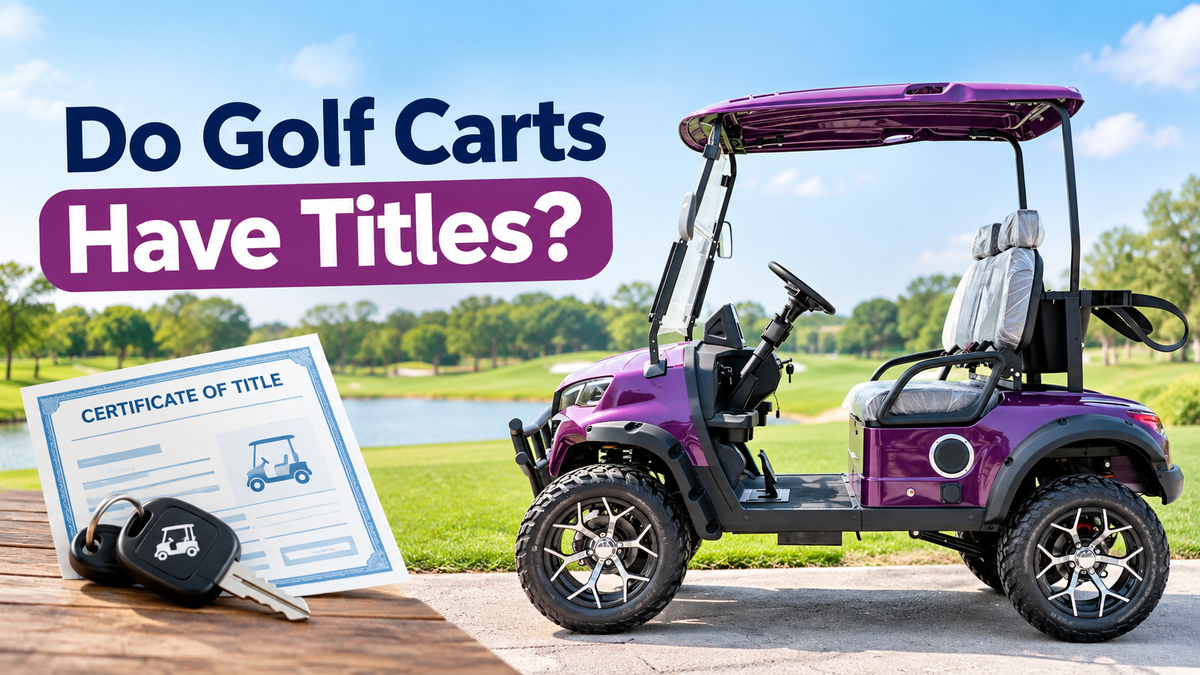
Do golf carts have titles? Usually, not in the same way cars do-but the answer depends on your state and how the golf cart is classified.
A standard golf cart used on a golf course, private property, or another area where normal motor-vehicle registration is not required may not have a state-issued title. In other situations, especially when a golf cart is classified and registered as a low-speed vehicle (LSV), title and registration requirements can apply.
Do Golf Carts Have Titles?
For GIYI Auto golf carts, buyers receive a bill of sale, purchase receipt, manufacturer documentation, and a serial number, rather than a standard vehicle title.
But once the vehicle falls under a state's title and registration requirements, the paperwork can be different. For example, Texas says the Texas Department of Motor Vehicles does not title or register ordinary golf carts, although qualifying golf carts can receive a golf-cart license plate through the county tax assessor-collector.
California takes a different approach. Its DMV has a title and registration process for qualifying golf carts used on-road and requires documentation establishing the vehicle's ownership.
Some golf carts have titles, some don't, and the absence of a title is not enough by itself to determine whether a golf cart was properly sold or legally owned.
Why Don't Some Golf Carts Have Titles?
Golf carts are commonly used on:
- Golf courses
- Private property
- Campgrounds
- Resorts
- Farms
- Gated communities
- Other areas where state or local law permits their use
If a golf cart isn't subject to the same title and registration requirements as a normal road vehicle, the ownership paperwork may be different.
The important question is not simply whether a title exists. It's whether the paperwork matches the vehicle and the laws where you live.
When Does a Golf Cart Need a Title?
A title becomes more relevant when the golf cart is being treated as a road-going motor vehicle under state law.
One important classification is a low-speed vehicle (LSV).
Federal Motor Vehicle Safety Standard 571.500 establishes safety requirements for low-speed vehicles and limits their maximum attainable speed to 25 mph. The standard also includes requirements for equipment such as headlights, turn signals, tail lamps, stop lamps, mirrors, a parking brake, windshield, VIN, and seat belts.
That doesn't mean every golf cart capable of reaching a particular speed automatically becomes an LSV. State classification and registration rules still matter.
This is why “golf cart” and “LSV” shouldn't automatically be treated as the same thing.
Golf Cart Title vs. Bill of Sale vs. MCO/MSO
Vehicle Title
A title is a state-issued ownership document.
If your state requires a particular golf cart or LSV to be titled, the title is an important part of the vehicle's ownership record.
Bill of Sale
A bill of sale documents the transaction between the buyer and seller.
For a used golf cart that doesn't have a title, a detailed bill of sale can be particularly important. It should identify the buyer, seller, vehicle, purchase price, date of sale, and the vehicle's identifying information.
A bill of sale does not automatically replace a title when state law requires a title.
MCO or MSO
A Manufacturer's Certificate of Origin (MCO) or Manufacturer's Statement of Origin (MSO) is manufacturer-origin paperwork associated with a new vehicle before it has gone through the state's normal title process.
This is one reason a new road-ready vehicle may have an MCO/MSO rather than a title in the manufacturer's or dealer's possession.
Texas, for example, specifically lists a Manufacturer Certificate of Origin, bill of sale, or invoice as acceptable ownership evidence for golf carts.
Do Golf Carts Have VIN Numbers?
Not every golf cart should be assumed to have the same type of vehicle identification as a passenger car.
A standard golf cart may have a manufacturer serial number or identification number.
A vehicle that qualifies as an LSV under the applicable federal requirements has a VIN requirement under FMVSS 571.500.
This distinction matters when you're buying a used golf cart.
If the seller says the cart is a street-legal LSV but cannot provide the identifying information or paperwork you would expect for that classification, it's worth stopping and checking the vehicle's status before paying.
Can You Buy a Golf Cart Without a Title?
Yes, potentially.
A golf cart without a title isn't automatically a bad purchase. In some states and situations, an ordinary golf cart may not be titled at all.
Instead, you should determine:
- Whether your state requires a title for that type of golf cart.
- Whether the seller actually owns the golf cart.
- Whether the serial number or VIN is present and readable.
- Whether the identification information matches the paperwork.
- Whether the seller can provide a bill of sale.
- Whether an MCO/MSO or original purchase paperwork exists.
- Whether the golf cart has previously been titled or registered.
- Whether you're buying it for private-property use or public-road use.
The biggest mistake is treating “no title” as either automatically normal or automatically suspicious.
What If the Seller Says the Title Was Lost?
This is different from a golf cart that was never titled.
If the golf cart should have a title under the applicable state rules but the seller says the title was lost, ask the seller to resolve the missing-title issue before completing the purchase.
You don't want to discover after payment that:
- The seller isn't the legal owner.
- The vehicle has conflicting ownership records.
- The VIN or serial number doesn't match.
- A previous title exists in another person's name.
- Your state requires documentation the seller cannot provide.
If the golf cart was never supposed to have a title, the seller should still be able to provide reasonable evidence of ownership and identify the vehicle.
What Should You Get When Buying a Golf Cart?
For a standard used golf cart, a practical paperwork package can include:
- Signed bill of sale
- Seller's name and contact information
- Buyer's name
- Purchase price
- Date of sale
- Golf-cart make and model
- Serial number
- VIN, if applicable
- Existing title, if the vehicle is titled
- MCO/MSO, if available
- Original dealer invoice or purchase receipt, if available
- Any state registration or permit documents that apply
You don't necessarily need every document on this list for every golf cart.
The point is to build a clear ownership trail that matches the actual vehicle.
How State Rules Can Change the Answer
Texas
Texas provides a clear example of why you shouldn't assume every golf cart needs a normal vehicle title.
TxDMV states that it does not title or register golf carts, although qualifying golf carts can receive a golf-cart license plate through the county tax assessor-collector. Texas also identifies situations in which a plated golf cart can be operated on certain roads.
California
California has a different process.
The California DMV provides a title/registration procedure for qualifying golf carts used on-road. The application can require a California Certificate of Title, manufacturer's certificate or statement of origin, bill of sale, or other acceptable ownership documents, along with vehicle verification and other required forms.
California also defines a golf cart using criteria that include a maximum designed speed of 15 mph, a maximum unladen weight of 1,300 pounds, and capacity for no more than two persons including the driver.
Florida
Florida distinguishes an ordinary golf cart from a converted golf cart that is being titled and registered as an LSV.
For a converted golf cart, Florida requires inspection and VIN assignment before the title and registration process.
What Should You Check Before Buying a Golf Cart Without a Title?
If you're looking at a used golf cart with no title, don't stop at the question “Does it have a title?”
Ask these questions instead:
1. Was this golf cart ever titled?
If the answer is no, find out why.
If the answer is yes but the title is missing, that's a different situation.
2. Can I see the serial number or VIN?
Make sure the identifying number is present and matches the paperwork.
3. Can you provide a bill of sale?
Get the sale documented in writing.
4. Do you have the original purchase paperwork?
A dealer invoice, receipt, MCO, or MSO can help establish the vehicle's history.
5. Has the golf cart been modified for street use?
If the seller describes it as an LSV or street-legal vehicle, ask for the corresponding paperwork rather than relying only on the seller's description.
6. What does my state require?
This is the final step because title, registration, plate, inspection, and road-use requirements can differ substantially by state.
Do Golf Carts Have Titles? Quick Answers
Do all golf carts have titles?
No. There is no universal requirement that every golf cart in the United States have a title. State law and vehicle classification determine what paperwork is required.
Can I buy a golf cart without a title?
Yes, in some situations. A standard golf cart may not be subject to title requirements. Before buying, verify ownership and check your state's requirements.
Is a bill of sale enough for a golf cart?
It can be important ownership documentation, but it is not universally a substitute for a title. If your state requires the vehicle to be titled, additional documentation may be necessary.
Do new golf carts come with titles?
Not necessarily. A new standard golf cart may come with a purchase invoice, receipt, serial number, or other ownership documentation instead of an existing title. A new road vehicle may have an MCO/MSO before its first title is issued.
Do golf carts have VIN numbers?
It depends on the vehicle and its classification. Standard golf carts may use manufacturer serial numbers, while vehicles subject to federal LSV requirements have VIN requirements.
Does an LSV need a title?
That depends on the state. LSVs are subject to federal safety standards, but state governments determine their title and registration procedures.
Is a golf cart without a title automatically suspicious?
No. The absence of a title can be normal for some golf carts. What matters is whether the vehicle should have a title under the applicable rules and whether the seller can provide a credible ownership history.



Leave a comment
This site is protected by hCaptcha and the hCaptcha Privacy Policy and Terms of Service apply.